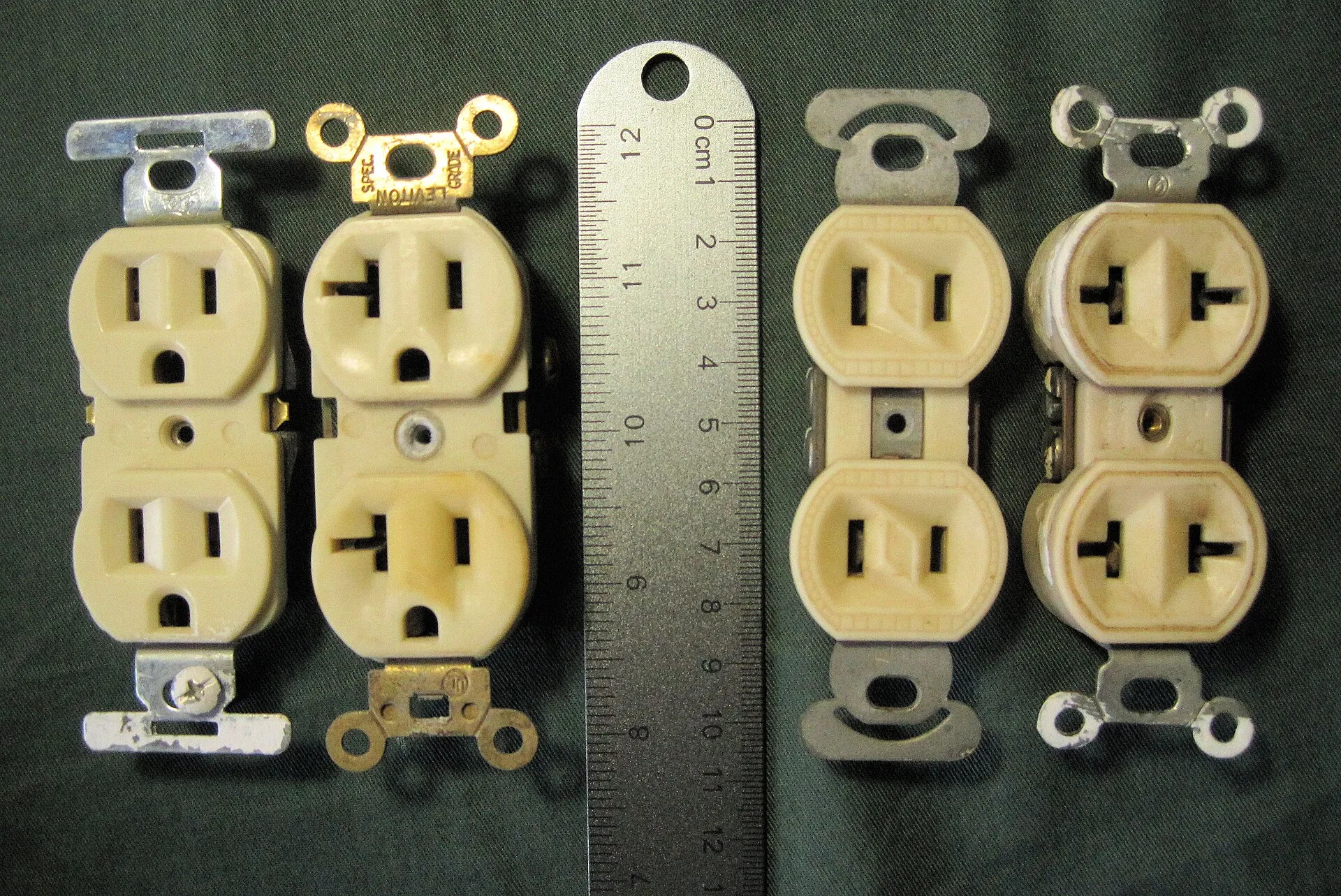
Plugs and voltage in Punta Cana
Photo: Yak99, Public domain, via Wikimedia Commons.

Punta Cana uses 120 V at 60 Hz with type A and B sockets, the same flat-pin system as the United States and Canada. That is the figure World Standards gives for the Dominican Republic. Some websites write 110 V for the same supply. If your devices come from North America, they plug in directly. Travelers from the UK, the EU and most other regions need a plug adapter and a quick check of each charger label.
Is the voltage 110 V or 120 V?
Both numbers appear online. The most reliable references say 120 V:
| Source | Voltage | Frequency | Plug types |
|---|---|---|---|
| World Standards | 120 V | 60 Hz | A, B |
| Wikipedia, Mains electricity by country | 120/208 V (and 277/480 V for industrial use) | 60 Hz | A, B, C |
The 110 V figure appears on some travel pages, but the two references above give 120 V, so this guide uses 120 V. For a traveler the difference is small: check that the label of your device covers 120 V. Both sources agree on 60 Hz.
Which plug types are used?
- Type A: two flat parallel pins, no earth pin.
- Type B: two flat pins plus a round earth pin.
- Type C: the two round pins of the common European plug. Wikipedia lists it for the Dominican Republic, World Standards does not. Do not count on finding a type C socket in your room.
A universal adapter covers every case, including the type C uncertainty.
Do you need an adapter or a converter?
An adapter changes the shape of the plug. A converter or transformer changes the voltage. They are different things.
| Where your device was bought | Plug adapter needed? | Voltage check |
|---|---|---|
| United States or Canada | No | Same 120 V standard, nothing to do |
| UK, most of Europe | Yes, to flat pins | Read the label: a 230 V-only device needs a converter |
The label on a charger or power brick shows the input range. A range such as 100-240 V means the device handles both standards, and only the plug needs an adapter. Phone, tablet, camera and laptop chargers are commonly in that group. Items such as hair dryers, straighteners and kettles are the usual problem, because many are single-voltage.
Which devices should you check before packing?
- Phone and laptop chargers: read the input line on the charger itself.
- Hair dryers and styling tools: check for a dual-voltage switch, or leave them at home and ask your hotel whether rooms have a dryer. This guide cannot say which resorts supply one.
- Electric razors and toothbrushes: many have wide-range chargers, but verify the label.
- CPAP and other medical devices: check the manual or ask the manufacturer, and carry a spare adapter.
- Power strips: a power strip rated for 120 V only suits devices from the US and Canada.
For a full checklist, see the packing list and the all-inclusive packing guide.
How do you read a charger label?
Look for the line marked INPUT on the charger or on the device itself. It shows voltage, frequency and current.
| What the label says | What it means in Punta Cana |
|---|---|
| INPUT 100-240 V, 50/60 Hz | Works on 120 V, 60 Hz. Only the plug shape may need an adapter. |
| INPUT 120 V, 60 Hz | Made for this supply. Works with a type A or B socket. |
| INPUT 220-240 V only | Not made for 120 V. Use it only with a proper converter rated for its wattage, or leave it at home. |
| No label visible | Check the manual or the manufacturer before plugging it in. |
Wattage matters when a converter is involved: heating appliances draw much more power than a phone charger, so a small converter is not suited to them. When in doubt, buy or borrow a dual-voltage version.
How do you charge devices on the go?
A power bank charged before you leave helps on excursions and boat trips. Keep a short, generic adapter in your day bag, since one adapter between several devices often becomes the bottleneck in a hotel room with few free sockets. If you rely on your phone for rides and maps, read getting around Punta Cana and SIM cards and eSIM, and look at wifi and connectivity at resorts.
What if your resort differs from the national tables?
The references above describe national standards, not individual properties, and this guide cannot verify the outlets of any single resort. If your plan depends on a particular socket, a dryer or a medical device, ask the hotel before you travel.
Frequently asked questions
What voltage does Punta Cana use?
The Dominican Republic is listed at 120 V and 60 Hz by World Standards and by Wikipedia's table of mains electricity by country. Some travel pages write 110 V instead. For devices, the label on the charger matters more than the exact number.
What plugs are used in Punta Cana?
World Standards lists plug types A and B, the flat-pin sockets used in the United States and Canada. Wikipedia's table adds type C. Because sources differ on type C, bring a universal adapter if your devices have anything other than flat pins, and ask the hotel front desk if they lend adapters.
Do you need a voltage converter in Punta Cana?
Usually not for phones, tablets and laptops, because most chargers accept a wide input range, often printed as 100-240 V on the label. Check each charger. Hair dryers, straighteners and other heating appliances built only for 220-240 V are the main risk, and a plug adapter alone does not change voltage.
Can I use US appliances in Punta Cana?
Yes. The listed 120 V, 60 Hz supply and type A and B sockets match standard US and Canadian equipment, so US-bought devices plug in directly without an adapter.